
Composer Vidyasagar takes you back to a bygone era.

Gnana Rajasekharan is ready with his new biopic.
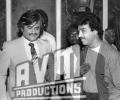
Whether it was in the company of superstars Rajinikanth and Kamal Haasan -- or, on rare occasions with both together, among others -- Saravanan's demeanour would stand out, observes N Sathiya Moorthy.

A Dravidian outfit has alleged that Rajinikanth uttered a 'blatant lie' that the images of Lord Ram and Sita were taken nude in a rally held by Periyar as part of superstition eradication conference in 1971 at Salem.

The DMK may consider a two-tier campaign, where they keep the focus on Chief Minister Stalin, as a senior statesman with 50-plus years of political experience, and let EPS and the BJP shout in the wilderness. In such a case, the second-tier may project Udhayanidhi as the contender and chosen obstructionist in Vijay's path. The attempt, if any, would be to reduce Vijay to Udhayanidhi's level when the former is aiming at Stalin and Stalin alone in the state's political horizon, predicts N Sathiya Moorthy.

If the Congress lost in Tamil Nadu in 1967, never to return, or the DMK and the AIADMK have kept their place in power and electoral politics since then, it owes not to their love or hatred for gods or for one religion over another. Instead, they had always been linked to performance and incumbency/anti-incumbency factors. There may be something in such constructs for Rajini's strategic team to consider, especially if the superstar is to enter direct politics by around this time next year. But then, they would need to brush up their homework more than at present, says N Sathiya Moorthy.

Prime Minister Narendra Modi on Wednesday "strongly disapproved" incidents of vandalism of statues in certain parts of the country and spoke to Home Minister Rajnath Singh on the matter.

If the DMK is able to sustain the momentum until the assembly polls, the AIADMK especially and the PMK and possibly the infant TVK too would find it hard to sign up with the BJP, explains N Sathiya Moorthy.
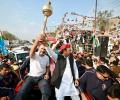
'They know that if they do not tie up with the Congress, then the minorities will move to the Congress.'

Udhayanidhi's 'untimely' elevation as deputy CM may be used against the party, for critics to argue that the DMK's 'first family's is not concerned about anything else but their clan's welfare. If packaged and delivered properly, some of the sting may stick at election time, predicts N Sathiya Moorthy.
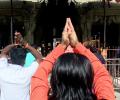
A district collector leads Dalits into a temple in Tamil Nadu, which is then sealed. A Ganesh Nadar finds out why.
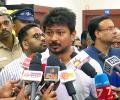
Udayanidhi has handed over to the BJP one real issue to draw the line between it and the INDIA alliance, predicts N Sathiya Moorthy.
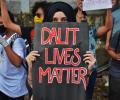
Tamil Nadu is the celebrated home of the 'social justice' movement in the country, yet caste differences and violence has only been increasing in numbers and becoming more brutal in recent years, observes N Sathiya Moorthy.
BJP veterans whom K Annamalai has reportedly sidelined are upset over his 'immature' way of handling allies, reveals N Sathiya Moorthy.
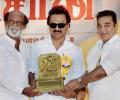
Rajinikanth said he stood by his comments made on Periyar, maintaining that they were factual and refused to apologise as demanded by fringe Dravidian outfits. DMK chief advised him to exercise caution while expressing views on Periyar.

Promising a corruption free, honest and transparent administration in Tamil Nadu, the party said it would work for up-gradation of economic and social status of Tamils

Any narrative against the Dravidian model may impact the BJP's prospects in Tamil Nadu. This may explain why the BJP in Tamil Nadu is placing more emphasis on corruption allegations against the DMK, even as the party focuses nationally on the Sanatana controversy.

The BJP continuing to look at the Dravidian polity through the religious prism has not worked in Tamil Nadu whereas it has yielded political and electoral results across much of the rest of the country, observes N Sathiya Moorthy.
He joined the All India Anna Dravida Munnethra Kazhagam after MGR founded the party and served in his ministry as Food, Labour and Health Minister till 1988.
Indications are that the DMK combine will win more seats than the AIADMK and BJP, but is facing a tough fight in about half a dozen from the rest, predicts N Sathiya Moorthy of the electoral contest in Tamil Nadu.

The inaugural Sangamam turned out to be a political Hindutva function than a gathering on the Hindu religion, observes N Sathiya Moorthy.
'With the deaths of Jayalalithaa and Karunanidhi, the BJP and Congress thought that they had a chance.' 'They have conceded that power is with the Dravidian parties.'

While Governor Ravi's speeches have put the local BJP supporters on the defensive in matters of religion and social justice, his add-on 'attack on the constitutional scheme' in the 'Senthil Balaji case', has been condemned squarely by many legal experts and editorial writers across the country, thus adding weight to CM Stalin's position -- at least until the courts come up with their binding views, observes N Sathiya Moorthy.

Medical seats for under-graduates and post-graduates remaining vacant in the NEET era, together with the Centre 'freezing' the number of medical colleges and seats in (Dravidian) Tamil Nadu and the launch of the PM's 'Vishwakarma Scheme' for the nation's craftsmen, are all seen as a bid to further reverse the state's progressive socio-economic agenda of and its achievements of the past hundred-plus years, argues N Sathiya Moorthy.

AIADMK supremo J Jayalalithaa is likely to make her first public appearance on Friday for a scheduled MLAs meet in Chennai, party officials said.

It is increasingly clear that for the BJP to try and establish itself as an electoral force in Tamil Nadu, the party has to come out of the old Brahminical mould, observes N Sathiya Moorthy.

From the voter-level, traditionally anti-BJP, anti-Hindutva minorities and other secular voters would have an option, especially in the face of the mounting anti-incumbency against the ruling party -- as it happened in the 2001 assembly polls, points out N Sathiya Moorthy.

Words and actions like those of R N Ravi and a vocal section of the state BJP have only added to Tamil fears and suspicions, points out N Sathiya Moorthy.

Chief Minister Stalin seems to have drawn a line between his personal beliefs and those of others in the family, beginning with wife Durga Stalin, observes N Sathiya Moorthy.
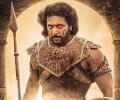
The aftermath of Mani Ratnam's Ponniyin Selvan has led to an argument that there was no religion as Hinduism in Chola times.
Instead, there was only Saivism, Vaishnavism, etc, and that the Cholas were Saivites, and hence not Hindus, observes N Sathiya Moorthy.

According to state government sources, not only did the governor insert some corrections, but he also initialled the final draft after those corrections had been made, reveals N Sathiya Moorthy.

Gowri Ramnarayan explores the world of Kalki Krishnamurthy whose magnificent novel Ponniyin Selvan has inspired Mani Ratnam's latest film PS I.

The Tamil Nadu chief minister may have opened a Pandora's Box on the religion front with the appointment of qualified non-Brahmin temple priests, observes N Sathiya Moorthy.
Tamil Nadu's unending legislative fight for exemption from NEET has now flagged the question if it's time to review the Supreme Court's famous verdict in the 'Mandal case', fixing 50-per cent upper-limit for all reservations, asks N Sathiya Moorthy.

Mani Ratnam is experimenting with a real-life historical in Ponniyin Selvan, points out N Sathiya Moorthy.
'Whatever good he did, all his achievements were overshadowed by the perception of corruption and other things.'

The Hindutva social media continues to present the DMK especially as anti-god, anti-Hindu and anti-Brahmin. The strategy did not work in the past, it has not worked in the present, and would not work in the future, as a massive vote-getter, asserts N Sathiya Moorthy.

The revived factionalism in the AIADMK, if not curbed now, has the potential to split the party vertically, warns N Sathiya Moorthy.
'A recent compromise by the state government is accepting NEET exams for medical entrance.'

Almost a century before the current Sabarimala movement -- to facililate the entry of women between the ages of 10 and 50 into the Kerala shrine -- there was the Vaikom temple movement, to throw open temples in Kerala to all castes, a movement led by among others a man whose 71st death anniversary we mark today. A fascinating excerpt from Rajmohan Gandhi's new book, Modern South India: A History From The 17th Century To Our Times.
